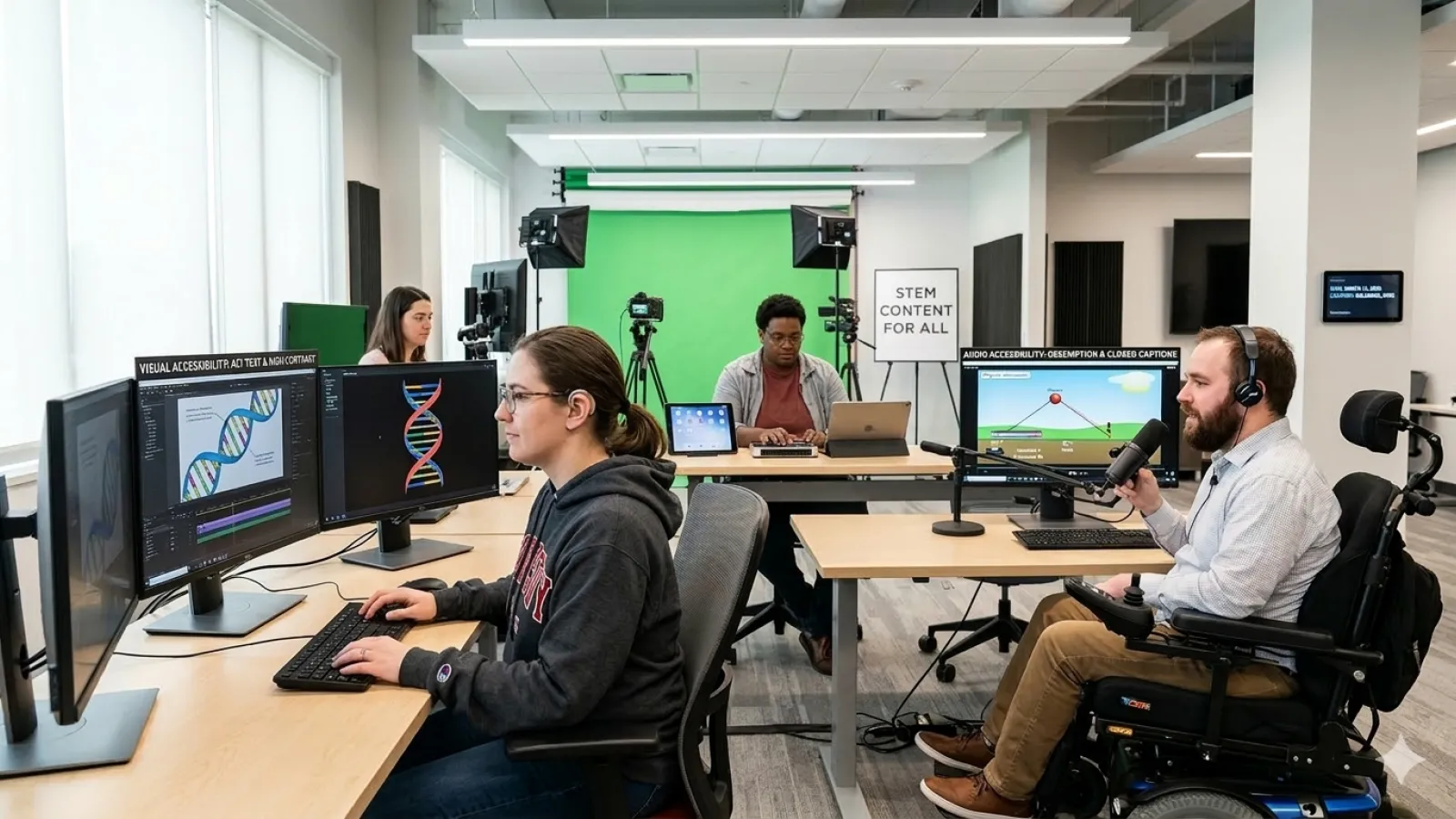
Accessible STEM Content
Learn about how to make accessible STEM documents.
Complex multi-line derivations, matrices, and integrals are genuinely hard to make accessible without some form of math markup. LaTeX is a document preparation system widely used in higher education, particularly in STEM disciplines, for producing complex mathematical notation, scientific articles, and research publications.
It excels at typesetting equations, managing references, and maintaining consistent formatting in long or highly technical documents.
However, traditional LaTeX workflows were not originally designed with digital accessibility in mind.
Generating properly tagged PDFs with meaningful document structure and accessible mathematical content requires specific packages, current distributions, and willingness to troubleshoot.
Producing fully PDF/UA-compliant, ADA Title II–compliant output from LaTeX is not consistently achievable for all types of documents.
LaTeX documents can be made accessible after they have been output to PDF, but this is time consuming and requires specialized skills. If the LaTeX source is changed and a new PDF created, the accessibility remediation process needs to start anew.
LaTeX Tagging
LaTeX development has been trying to address these issues through the LaTeX tagging project.
When using the most recent LaTeX engines and a collection of compatible packages, fully accessible PDFs from LaTeX are possible.
When working with LaTeX that uses packages that are incompatible with tagging, changes to existing and legacy documents will be required to support tagged PDFs and accessible mathematics.
Following are some links that describe LaTeX commands and markup that should be used to generate tagged, accessible PDFs.
Advice for Making Tagged LaTeX Documents
Resources
Tool Kit for Building Accessibility into STEM Workflows
The tools outlined in this STEM Accessibility Toolkit collectively support an end-to-end workflow for creating accessible STEM content.
Authoring tools such as Microsoft’s Equation Editor enable faculty to create structured mathematical expressions rather than image-based equations, which is foundational for screen reader compatibility.
Web-based rendering tools like MathJax improve accessibility of LaTeX embedded in web pages, while Pandoc can assist in converting LaTeX content into more accessible formats such as HTML or DOCX.
Remediation platforms including Adobe Acrobat Pro, CommonLook PDF, and Equidox allow staff to correct tagging, reading order, and structural issues in complex PDFs.
Microsoft Equation Editor
Microsoft’s built-in Equation Editor allows authors to create structured mathematical notation that is more accessible than image-based equations.
Use the Equation Editor to insert any mathematical notation.
When Office documents are exported as a tagged PDF, equations can be interpreted by assistive technologies.
Currently accessibility support is better in Word than in PowerPoint, but better PowerPoint support is promised soon.
Overleaf
Overleaf is a LaTeX environment in the cloud.
You benefit by not needing to maintain your own LaTeX installation.
Overleaf provides the latest compiler versions that are required to generate tagged and accessible PDFs.
You can create a free account, or some departments have subscriptions and may be able to provide you with a license.
A license will allow you to invite collaborators to your projects, and you will be accessing more powerful servers, leading to faster compile times.
Mathpix
Mathpix is an AI-powered Optical Character Recognition tool for STEM that converts math, science, and technical content from images, PDFs, and screenshots into editable digital formats such as LaTeX, Markdown, DOCX, HTML, MathML, and plain text.
It is widely used by researchers, faculty, and students to quickly “snip” equations, tables, chemistry notation, and even full PDFs and turn them into machine-readable, searchable documents or code for use in editors like Overleaf, Word, and other writing tools.
MathJax
MathJax is a JavaScript display engine for rendering mathematics in web browsers.
It supports accessibility extensions and works well for HTML-based STEM content in learning management systems and websites.
Pandoc
Pandoc is a document conversion tool that can convert LaTeX into HTML or DOCX formats.
It supports MathML output and is useful in remediation workflows.
LaTeX that is problematic for converting to accessible PDF can sometimes be more accessible when exported to HTML using Pandoc.
If it’s possible for you to distribute your LaTeX content as HTML instead of PDF this can be a good option.
Pandoc has an implementation that runs fully in the browser. This makes it easy to experiment with converting your content without needing to install anything.
Panopto
Panopto provides captioning tools and transcript editing features to improve accessibility of recorded STEM lectures and instructional videos.
CarmenCanvas
LaTeX code can be used directly in CarmenCanvas.
ASC’s Office of Distance Education has a good support article explaining its use.